

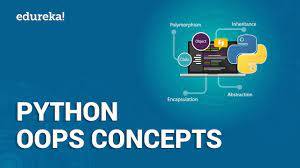





OOPS
Python OOPs Concepts
Like other general-purpose programming languages, Python is also an object-oriented language since its beginning. It allows us to develop applications using an Object-Oriented approach. In Python, we can easily create and use classes and objects.
An object-oriented paradigm is to design the program using classes and objects. The object is related to real-word entities such as book, house, pencil, etc. The oops concept focuses on writing the reusable code. It is a widespread technique to solve the problem by creating objects.
Major principles of object-oriented programming system are given below.
The class can be defined as a collection of objects. It is a logical entity that has some specific attributes and methods. For example: if you have an employee class, then it should contain an attribute and method, i.e. an email id, name, age, salary, etc.
Syntax
The object is an entity that has state and behavior. It may be any real-world object like the mouse, keyboard, chair, table, pen, etc.
Everything in Python is an object, and almost everything has attributes and methods. All functions have a built-in attribute __doc__, which returns the docstring defined in the function source code.
When we define a class, it needs to create an object to allocate the memory. Consider the following example.
Example:
Output:
Toyota 2016
In the above example, we have created the class named car, and it has two attributes modelname and year. We have created a c1 object to access the class attribute. The c1 object will allocate memory for these values. We will learn more about class and object in the next tutorial.
The method is a function that is associated with an object. In Python, a method is not unique to class instances. Any object type can have methods.
Inheritance is the most important aspect of object-oriented programming, which simulates the real-world concept of inheritance. It specifies that the child object acquires all the properties and behaviors of the parent object.
By using inheritance, we can create a class which uses all the properties and behavior of another class. The new class is known as a derived class or child class, and the one whose properties are acquired is known as a base class or parent class.
It provides the re-usability of the code.
Polymorphism contains two words "poly" and "morphs". Poly means many, and morph means shape. By polymorphism, we understand that one task can be performed in different ways. For example - you have a class animal, and all animals speak. But they speak differently. Here, the "speak" behavior is polymorphic in a sense and depends on the animal. So, the abstract "animal" concept does not actually "speak", but specific animals (like dogs and cats) have a concrete implementation of the action "speak".
Encapsulation is also an essential aspect of object-oriented programming. It is used to restrict access to methods and variables. In encapsulation, code and data are wrapped together within a single unit from being modified by accident.
Data abstraction and encapsulation both are often used as synonyms. Both are nearly synonyms because data abstraction is achieved through encapsulation.
Abstraction is used to hide internal details and show only functionalities. Abstracting something means to give names to things so that the name captures the core of what a function or a whole program does.

Creative Knowledge From Various Good Teachers From Various Locations. Knowledge is Free Always
.jpg)

