





logo

Concept of Numbers

  • No Rating
  • (0 Reviews)
  • 0 User Enrolled

Concept of Numbers

Number concepts are the interesting properties that exist between numbers. These ideas help us perform calculations and solve problems.

  • No Rating
  • (0 Reviews)
  • 0 User Enrolled
  • Free
10-Day Money-Back Guarantee


Course Content

4 sections • 17 lectures • 02h 21m total length
Concept of Number

Concept of Number

preview 5min
What is 'Zero' 0?

What is 'Zero' 0? 

preview 5min
Ones & Tens

Ones & Tens 

preview 10min
Even and Odd

Even and Odd Numbers Song

preview 5min
Types of Numbers Song

Types of Numbers Song

preview 5min
Types of Numbers

What Are The Different Types of Numbers?

preview 10min
various types of numbers

various types of numbers

preview 10min
Introduction to Number Theory

Introduction to Number Theory

preview 10min
Learning Factors

Learning Factors

preview 10min
Highest Common Factor

Common Factor

preview 10min
multiples

What are multiples?

preview 5min
Least Common Multiple

Least Common Multiple 

preview 10min
Why do two odd numbers always equal an even number?

Why do two odd numbers always equal an even number?

preview 5min
Prime and Composite Numbers

Prime and Composite Numbers

preview 5min
prime factorisation

prime factorisation

preview 20min
LCM by Prime Factorisation Method

LCM by Prime Factorisation Method

preview 6min
An introduction to mathematical theorems

An introduction to mathematical theorems

preview 10min

Requirements

  • Notebook

Description

What is Numbers?

We count things using numbers. 

For example, this is one butterfly and these are 4 butterflies.

numbers

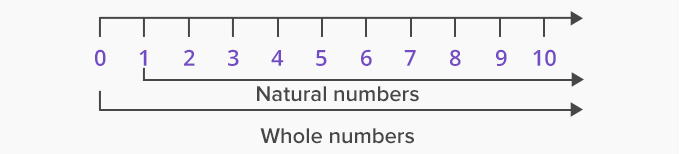
We start counting things from 1. The numbers 1, 2, 3, 4, ... are called counting numbers or natural numbers. How do we count something that was there and is no more?

For example, if there were 4 puppies and now there’s none. How do we show none or nothing?

We use Zero (0) to show nothing. The counting numbers or natural numbers along with zero form whole numbers. 
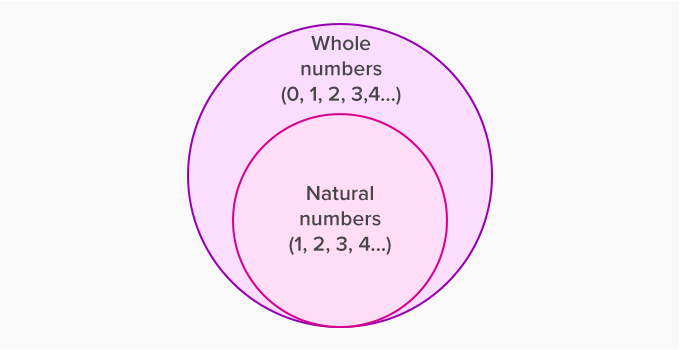
Whole Numbers

Whole Numbers 1

We use the digits 0 to 9 to form all the other numbers. Using these 10 digits we can form infinite numbers.

Whole number example

For example, 121; 34987; 2987633; 459227904; ...

This number system using 10 digits is called Decimal Number System. There are many ways in which we can classify numbers.

What's always true when adding or multiplying odd and even numbers?

The following properties are true whenever odd or even numbers are added or multiplied.
Addition
  • The sum of two odd numbers is even.
  • The sum of two even numbers is even.
  • The sum of an odd and an even number is odd.
Multiplication
  • The product of two odd numbers is odd.
  • The product of two even numbers is even.
  • The product of an odd and an even number is even.
Knowing about these properties is useful, but it isn't necessary to memorize them! To recall any of the above properties, create a simple example for the property you need.
 

What are factors and how do we find them?

Factors are whole numbers that divide evenly (no remainder) into another whole number. To find the factors of a number, we can use a calculator or the divisibility rules. 
Factoring a number means listing all its factors. The factors are usually presented in a list ordered from least to greatest.
One way to create a list of factors is to start checking for factor pairs beginning at 1 and checking each subsequent integer. We can stop checking for factors when we get to an integer that's already been paired with a previous factor.
 

What is prime factorization?

Prime numbers are whole numbers greater than 1 whose only factors are 1 and itself. For example, 17 is prime because it is only divisible by 1 and 17.Prime factorization means writing a number as a product of factors that are all prime numbers. Prime factorization is helpful when finding the greatest common factor or least common multiple, but is not the only way to do it.
 

What is the greatest common factor?

The greatest common factor (or greatest common divisor) of two numbers is the largest whole number that both numbers are divisible by.
We can find the greatest common factor one of two ways:
  • List the factors of each number and select the largest common factor.
  • Write the prime factorization of each number and then multiply all common factors.

What are multiples?

multiple is a number that results when we multiply a whole number by another non-zero whole number. To find the first few multiples of a number, multiply the number by whole numbers starting with 1.
 

What is the least common multiple?

The least common multiple of two numbers is the smallest whole number that is divisible by both numbers.We can find the least common multiple one of two ways:
  • List the multiples of each number until we find a common multiple.
  • Multiply together all the unique factors in the prime factorization of both numbers.


Recently Added Courses

blog
Last Updated 13th June 2025
  • 6
  • Free
blog
Last Updated 13th June 2025
  • 0
  • Free
blog
Last Updated 28th May 2025
  • 2
  • Free
blog
Last Updated 28th May 2025
  • 0
  • 19.00₹
  • 100.00₹

About the Instructor

instructor
About the Instructor

Creative Knowledge From Various Good Teachers From Various Locations. Knowledge is Free Always