In this chapter you will learn about friction in general ways of life.
4min
Static Friction
What is static friction?
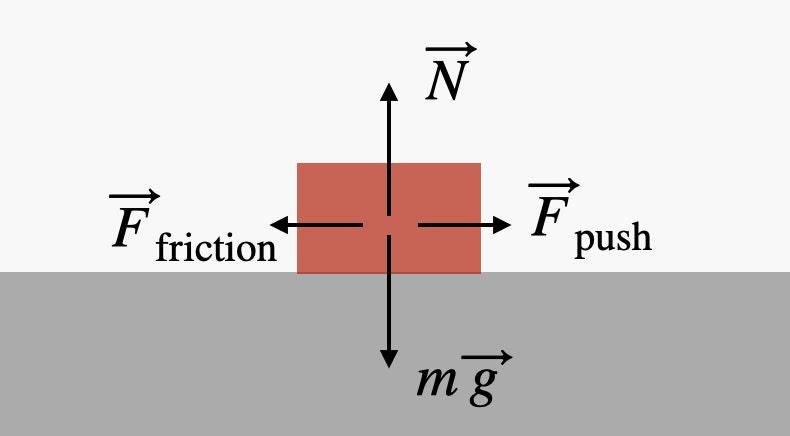
Let consider to push a couch across the floor. You push it with a small force, but it does not move at all. This is because it is not accelerating. Newton's law tells us that resultant force on the body is zero. There must be a second horizontal force acting on the couch, one that opposes your force and is equal in magnitude. This force is static frictional force which is the force extended on the surface by one another when there is no motion between the two surfaces. Static friction force acts in response to a force trying to cause a stationary body start moving. When no force acts on the body, then static friction force is zero. If there is a force causing a body to move, then this static frictional force increases up to the maximum static frictional force.
Maximum static frictional tries to prevent a stationary object to maximum extent to start moving,
5min
Kinetic Friction
The most straightforward kinetic friction definition is: the resistance to motion caused by the contact between a surface and the object moving against it. The force of kinetic friction acts to oppose the motion of the object, so if you push something forward, friction pushes it backwards.
The kinetic fiction force only applies to an object that is moving (hence “kinetic”), and is otherwise known as sliding friction. This is the force that opposes sliding motion (pushing a box across floorboards), and there are specific coefficients of friction for this and other types of friction (such as rolling friction).
The other major type of friction between solids is static friction, and this is the resistance to motion caused by the friction between a still object and a surface. The coefficient of static friction is generally larger than the coefficient of kinetic friction, indicating that the force of friction is weaker for objects that are already in motion.
20min
Rolling Friction
Rolling Friction is the force resisting the motion when a body (such as a ball, a tire, or wheel) rolls on a surface. It is mainly caused by non-elastic effects; that is, not all the energy needed for deformation (or movement) of the wheel, roadbed, etc., is recovered when the pressure is removed
5min
Fluid Friction
Fluid friction is the force that resists motion either within the fluid itself or of another medium moving through the fluid. There is internal friction, which is a result of the interactions between molecules of the fluid, and there is external friction, which refers to how a fluid interacts with other matter.
min
Requirements
No Requirement
Description
Friction is the force resisting the relative motion of solid surfaces, fluid layers, and material element sliding against each other. There are several types of friction:
Dry frictionis a force that opposes the relative lateral motion of two solid surfaces in contact. Dry friction is subdivided into static friction between non-moving surfaces, and kinetic friction between moving surfaces. With the exception of atomic or molecular friction, dry friction generally arises from the interaction of surface features, known as asperities.
Fluid frictiondescribes the friction between layers of a viscous fluid that are moving relative to each other.
Lubricated frictionis a case of fluid friction where a lubricant fluid separates two solid surfaces.
Skin frictionis a component of drag, the force resisting the motion of a fluid across the surface of a body.
Internal frictionis the force resisting motion between the elements making up a solid material while it undergoes deformation.
When surfaces in contact move relative to each other, the friction between the two surfaces converts kinetic energy into thermal energy (that is, it converts work to heat). This property can have dramatic consequences, as illustrated by the use of friction created by rubbing pieces of wood together to start a fire. Kinetic energy is converted to thermal energy whenever motion with friction occurs, for example when a viscous fluid is stirred. Another important consequence of many types of friction can be wear, which may lead to performance degradation or damage to components. Friction is a component of the science of tribology.
Friction is desirable and important in supplying traction to facilitate motion on land. Most land transport rely on friction for acceleration, deceleration and changing direction. Sudden reductions in traction can cause loss of control and accidents.
Friction is not itself a fundamental force. Dry friction arises from a combination of inter-surface adhesion, surface roughness, surface deformation, and surface contamination. The complexity of these interactions makes the calculation of friction from first principle impractical and necessitates the use of empirical methods for analysis and the development of theory.
Friction is a non-conservative force – work done against friction is path dependent. In the presence of friction, some kinetic energy is always transformed to thermal energy, so mechanical energy is not conserved.








.jpg)